




Live Oak may be small compared with San Antonio, but its location gives residents access to a surprisingly large amount of shopping, employment, healthcare, recreation and education without requiring a long trip across the metro area.
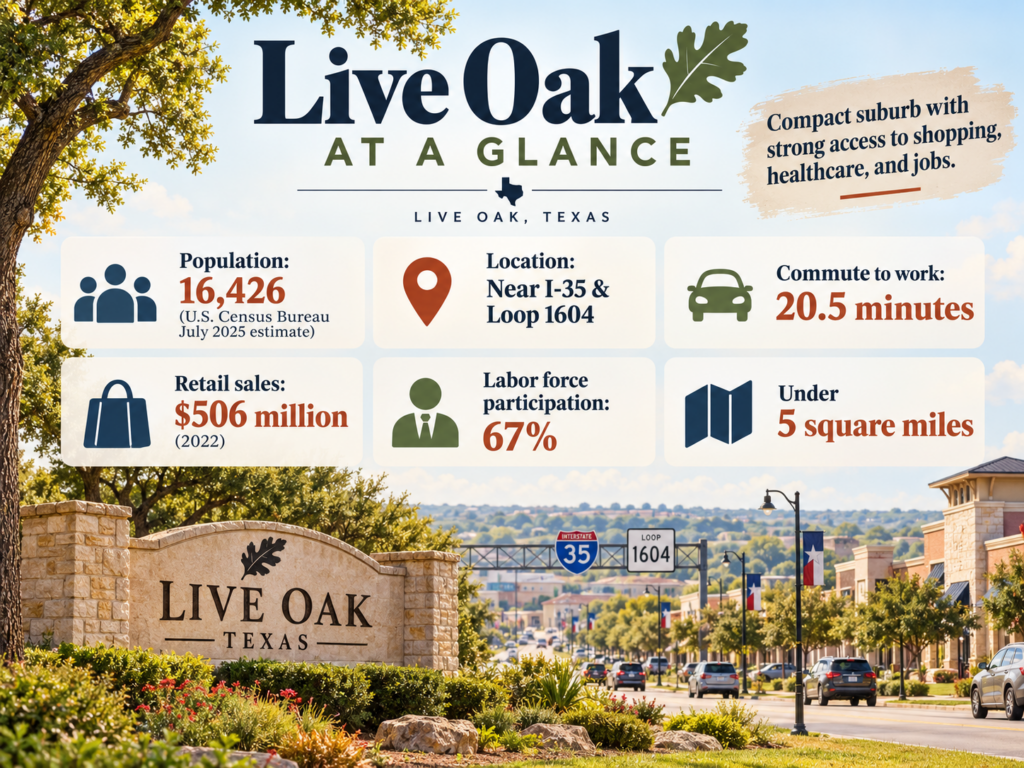
Located on the northeast side of the San Antonio metropolitan area near the intersection of Interstate 35 and Loop 1604, Live Oak covers less than five square miles but sits in the middle of one of the region’s busiest suburban corridors. The city is surrounded by communities including Universal City, Selma and San Antonio, with Randolph Air Force Base only a few miles away.
Live Oak had 15,781 residents in the 2020 Census. The U.S. Census Bureau’s July 2025 population estimate was 16,426, representing growth of about 4.1% from the 2020 estimates base. That makes Live Oak considerably more established than some of the fast-growing outer suburbs around San Antonio, where new subdivisions are still adding thousands of residents at a time.
That established feel is part of Live Oak’s appeal. Residents can live in a relatively compact suburban community while remaining close to major highways, shopping centers, medical facilities, colleges and employment centers throughout northeast San Antonio.

Jobs in Live Oak
Live Oak benefits heavily from its location along the I-35 corridor. Residents can reach employment centers in San Antonio, Schertz, Selma, Universal City, New Braunfels and other nearby communities without living in the urban core. Census data for 2020-2024 puts the average commute to work at 20.5 minutes, while 67% of residents age 16 and older participate in the civilian labor force.
Healthcare is becoming an especially important part of the local economy. Methodist Hospital Northeast, located on Judson Road in Live Oak, is undergoing a major expansion in 2026. Methodist broke ground in January on a $146 million, more than 100,000-square-foot patient tower that will add critical-care and medical-surgical beds and increase hospital capacity from 237 to 295 beds.
The broader medical district is growing as well. Live Oak’s most recent financial reporting describes additional medical office development and plans for a new three-story physical rehabilitation hospital on Toepperwein Road that is expected to create more than 100 jobs.
Retail is another major part of the local economy. Census data recorded more than $506 million in retail sales in 2022within Live Oak, an unusually large amount for a city of roughly 16,000 residents. That reflects Live Oak’s role as a regional shopping destination rather than a retail market serving only its own residents.
The city’s location also puts it close to military employment. Live Oak’s tourism office places Randolph Air Force Base about 3.4 miles away and Fort Sam Houston approximately 10 miles away, adding another significant employment base within the surrounding area.
Education in Live Oak
Live Oak is closely tied to Judson Independent School District, whose administrative offices are located on Shin Oak Drive in the city. Because attendance boundaries can change and individual addresses may have different assigned campuses, renters and landlords should confirm the current school assignment for a specific property rather than relying only on the city name.
One particularly notable campus is Judson Early College Academy, located in Live Oak on Palisades Drive. The program combines high school education with college coursework through a partnership with nearby Northeast Lakeview College. In 2025, all 86 members of one graduating class were on track to receive both a distinguished high school diploma and an associate degree.
Higher education is especially accessible. Northeast Lakeview College, part of the Alamo Colleges District, sits just outside Live Oak in neighboring Universal City near Loop 1604 and Kitty Hawk Road. Certified fall 2025 enrollment reached 10,562 students, and the college offers associate degrees, certificates, transfer programs and workforce education.
That proximity gives Live Oak residents an unusually convenient higher-education option for a suburban community of its size. The college is also an important part of the area’s workforce-development strategy, particularly as healthcare, skilled trades and other industries continue growing along the northeast corridor.
Quality of Life in Live Oak
Live Oak’s compact size does not mean it is short on green space.
The city’s Parks and Recreation Department maintains more than 100 acres of parkland, including Main City Park, Lakeside Park and Woodcrest Nature Park. The park system includes baseball fields, a football field, playgrounds, a skate park, walking areas and two 18-hole disc golf courses.
Main City Park is the centerpiece. The approximately 75-acre park includes a lake, basketball court, football field, three baseball fields, multiple playgrounds, picnic areas and a disc golf course. A trail circles the lake and extends for nearly two miles, giving residents a place to walk, jog or spend time outdoors without leaving the city.
Woodcrest Nature Park offers a different experience, with walking and jogging trails, climbing features, elevated platforms and shaded areas. The city also organizes community events throughout the year, including seasonal celebrations, fishing events, holiday programs and the annual Shindig on Shin Oak festival.
Live Oak is still fundamentally a driving community. Its biggest advantage is not walkability but location. Interstate 35 and Loop 1604 put residents near some of the largest employment, shopping and entertainment districts on San Antonio’s northeast side.
Public transportation is also more limited than it is inside San Antonio itself. VIA Metropolitan Transit identifies Live Oak as one of the suburban municipalities outside its regular service area, which means residents should generally plan on using a personal vehicle for everyday transportation.
Shopping, Dining and Entertainment in Live Oak
For a city of its size, Live Oak has an unusually large retail footprint.
The biggest concentration is The Forum at Olympia Parkway, located around the I-35 and Loop 1604 interchange. The outdoor shopping district encompasses approximately 1.5 million square feet and includes major retailers such as Target, Home Depot, Best Buy and Kohl’s, along with numerous restaurants and smaller stores.
The surrounding commercial area adds even more options. Live Oak Crossing includes additional restaurants, retail and entertainment, including a Regal movie theater. Other shopping centers in and around the city include Gateway Plaza and the Village at Forum Parkway.
The retail mix continues to change as well. Recent economic-development efforts have included expansion around Live Oak Town Center and the arrival of larger destination retailers, while healthcare development has added another commercial anchor on the opposite side of the city. Live Oak’s 2024 economic-development report specifically highlighted the addition of Dick’s House of Sport at Live Oak Town Center as one of the year’s major business developments.
Residents also have easy access to attractions outside the city limits. Morgan’s Wonderland is roughly five miles away, Natural Bridge Wildlife Ranch is about 13 miles away and San Antonio International Airport is approximately 11 miles from Live Oak, according to the city’s tourism office.
Cost of Living in Live Oak
Live Oak’s housing market is another place where its established suburban character shows.
The Census Bureau reports a median value of $246,300 for owner-occupied homes based on 2020-2024 data. The owner-occupancy rate was 57.9%, meaning rental housing represents a substantial part of the local market as well.
For renters, the Census Bureau reports median gross rent of $1,634 per month for 2020-2024. As with the figures used in our other Neighborhood Spotlights, gross rent is not the same thing as the asking rent for a newly listed house or apartment in 2026. It is a Census measure that includes contract rent and certain utility costs, but it gives a useful baseline for comparing Live Oak with other communities.
Median household income was $79,696, while per-capita income was $41,485 in the same Census period. The city’s poverty rate was 5.5%.
For landlords and renters, Live Oak sits in an interesting position. It is an established, relatively compact community rather than a distant new-growth suburb, yet it provides quick access to one of the busiest commercial corridors in northeast San Antonio. Housing costs need to be evaluated property by property, but the combination of medical employment, retail, nearby military installations, higher education and highway access creates several sources of potential housing demand.
Other Notable Facts About Live Oak
- Live Oak incorporated in 1960 with only 316 residents. The city’s founders saw the area around what would become the I-35 and Loop 1604 interchange as an ideal location for a new community.
- The original community had strong German roots, with early local families including the Englemans, Riedels, Feys, Albrechts, Schumanns and Friesenhahns. Residents initially participated in Selma’s incorporation before separating and creating the City of Live Oak.
- By the 1970 Census, only a decade after incorporation, Live Oak’s population had already grown to 2,779. The Census Bureau’s 2025 estimate of 16,426 means the city now has more than five times as many residents as it did in 1970.
- Main City Park was created from land donated in the early 1970s and has an archaeological history. The city says the park area was petitioned for recognition as a Texas historical site in 1979 because of evidence of an old Native American campsite discovered there.
- Live Oak sits only a few miles from Randolph Air Force Base, making the city particularly well positioned for households connected to the military and civilian defense workforce on San Antonio’s northeast side.
- Despite having only about 16,000 residents, Live Oak functions as a much larger commercial center because The Forum, its medical district and the I-35/Loop 1604 interchange draw shoppers, patients and workers from communities throughout northeast San Antonio. The city’s retail sales exceeded $500 million in the Census Bureau’s most recent published business data.
The city’s official website is LiveOakTX.net.