



This Content Is Only For Subscribers
A rental property can run smoothly for years and still produce a legal problem in a single week. A tenant disputes a deposit deduction. An HVAC repair takes longer than expected. A lease violation turns into an eviction. A storm damages the property and the insurance carrier asks for records. In each situation, the landlord who can produce a clean file is in a much better position than the landlord who has to reconstruct the tenancy from memory.
Welcome to Landlord Legal Lowdown. For San Antonio and South Texas landlords, a compliance binder is less about creating more paperwork and more about keeping the right paperwork in one place.
The binder can be physical, digital, or both. What matters is that it follows the tenancy from application through move out and that the important records are easy to retrieve. The sections below are the ones I would want in every active landlord file.

The Lease and Addenda
Start with the fully executed lease. Keep every signed addendum with it, including pet agreements, parking rules, pool or spa responsibilities, utility agreements, and any later amendments. If the property was built before 1978 and federal lead disclosure rules apply, keep the signed lead disclosure documents and required acknowledgment. Federal rules require those acknowledgments to be retained for three years after the lease begins, but keeping them with the lease file longer is usually simpler.
Do not treat the lease as one isolated document. The actual agreement may include several attachments that control important issues. If a tenant is permitted to keep one dog, if the landlord is responsible for lawn service, or if a pool agreement assigns routine maintenance tasks, the signed addendum is part of the story.
Texas Property Code Section 92.024 also requires the landlord to provide at least one complete copy of the lease to at least one tenant no later than the third business day after the lease is signed by each party. Keep proof of delivery. An email, portal log, or signed acknowledgment can make that easy to establish later.
Security Devices and Rekeying
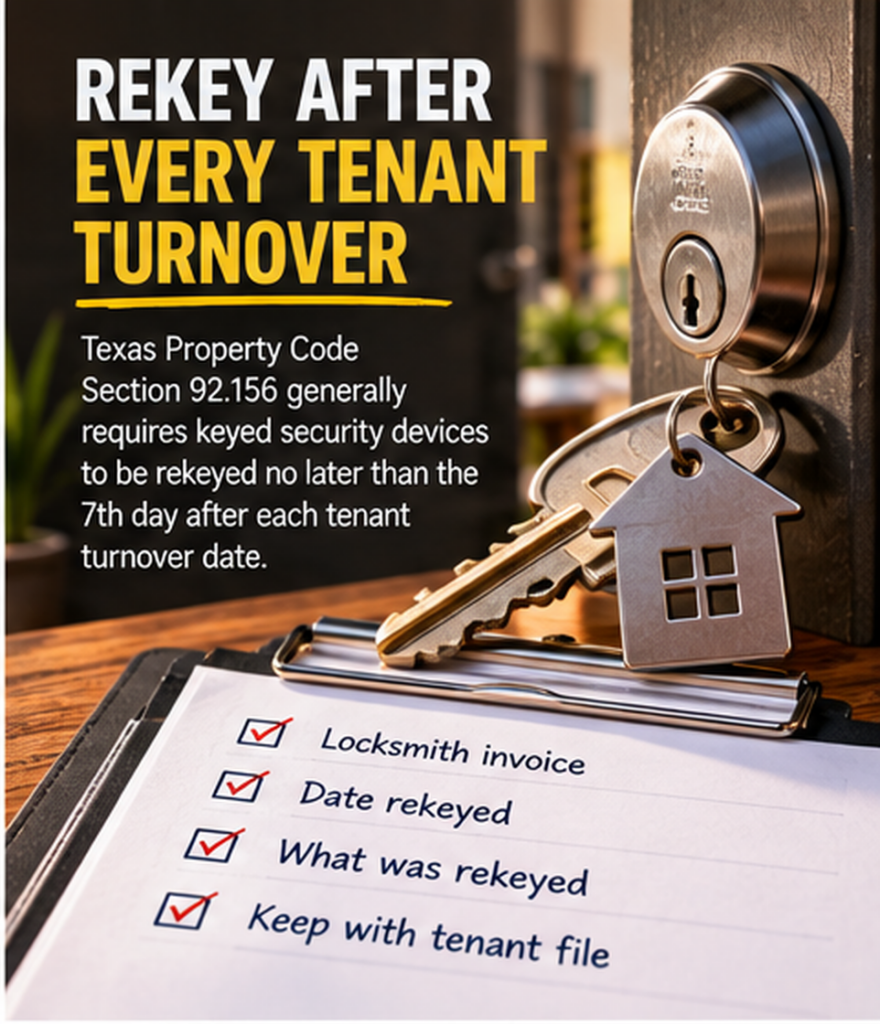
Texas has detailed security device requirements, and a landlord should keep a record showing how those duties were handled. Section 92.156 generally requires keyed security devices to be rekeyed at the landlord’s expense no later than the seventh day after each tenant turnover date. Keep the locksmith invoice or a dated maintenance record showing what was rekeyed and when.
Also keep records of any later tenant requests involving security devices and the work performed in response. A short work order with the request date, completion date, and invoice is more useful than relying on someone to remember a lock change two years later.
For San Antonio landlords with several houses in different parts of Bexar County or farther into South Texas, vendor records can also help you see which locksmiths actually serve each area and how quickly they respond. The legal file can double as a useful operating history.
Smoke Alarm Records
Texas Property Code Section 92.258 requires the landlord to determine that required smoke alarms are in good working order at the beginning of the tenant’s possession. The law allows testing by the alarm’s test button, smoke, or another manufacturer recommended procedure. During the lease or a renewal, the landlord’s inspection and repair duty generally arises after the tenant reports a malfunction or requests inspection or repair.
Keep a dated move in checklist showing that the alarms were tested and working. Photographs can help, especially if they show location and installation, but they do not replace the actual test. If the tenant later reports a problem, keep that notice and the repair record with the original inspection. The goal is a simple timeline that shows what was working, what was reported, and what was done.
Maintenance Requests and Repair Records
Repair files deserve their own section because Texas repair law depends heavily on notice, timing, the seriousness of the condition, and the landlord’s response. Under Section 92.052, the tenant must specify the condition to the person or place where rent is normally paid, the tenant generally must not be delinquent in rent when notice is given, and the condition must materially affect the physical health or safety of an ordinary tenant or involve the statutory hot water requirement. A repair notice must be in writing only if the written lease requires written notice.
For every significant repair, keep the tenant notice, your acknowledgment, vendor calls or work orders, delay communications, photographs when useful, and the final invoice. Section 92.056 focuses on reasonable time and diligent effort, not a single universal repair deadline for every problem. A good file shows that you acted promptly and kept working toward a solution.
That documentation matters in South Texas during peak summer demand. If an air conditioner fails in August and the first available technician is two days away, save the messages showing when the tenant reported the failure, when vendors were contacted, what temporary steps were discussed, and when the repair was completed. Documentation does not excuse delay, but it can show whether you made a diligent effort.
Move In and Move Out Condition Records
Security deposit disputes are much easier to handle when the condition file is organized. Keep the tenant’s move in condition form, your own inspection notes, and date stamped photographs or video. When the tenant leaves, document the condition again before cleaning or repairs change the scene.
Texas Property Code Section 92.104 does not allow a landlord to retain a security deposit for normal wear and tear. That makes the comparison between move in and move out more important than any single form. If you charge for a damaged door, broken blind, or wall repair, your file should make it easy to see the prior condition, the move out condition, and the actual repair cost.
The timing of the deposit also matters. Section 92.103 generally requires the landlord to refund the deposit on or before the 30th day after the tenant surrenders the premises, subject to Section 92.107, which says the landlord is not obligated to return the deposit or provide the itemized description until the tenant gives a written forwarding address. Keep the forwarding address, itemized statement, invoices, and proof of mailing together.
Ledgers and Payment Records
Every tenant file should contain a clear ledger showing charges, payments, credits, fees, and the dates they were posted. If a tenant falls behind, the ledger should tell the story without requiring you to compare bank deposits with handwritten notes.
This is especially important before filing a nonpayment case. Review the ledger against the lease, check how partial payments were applied, and make sure the balance you are claiming is accurate. A Justice Court may see many landlord tenant cases in a day. A clean ledger makes your explanation easier to follow.
If you accept cash rent, Section 92.011 requires a written receipt and requires the landlord to enter the payment date and amount in a record book, unless the written lease requires payment by check, money order, or another traceable or negotiable instrument. Keep copies of the receipts with the ledger.
Formal Notices and Proof of Delivery
Notices should have their own section. Keep lease violation notices, nonrenewal notices, rent change notices, Notices to Vacate, and any other formal correspondence that may affect enforcement. The correct method depends on the particular notice, the lease, and the statute that applies.
For a Notice to Vacate, Section 24.005 contains specific delivery rules. Keep the notice and the proof of delivery together. Depending on the method used, that may include tracking records, mailing documentation, a delivery record, or a dated record of personal delivery or posting when permitted by law. Before filing an eviction, confirm that the notice period, content, and delivery method match the current law and the lease.
This is particularly important when properties are spread across different Justice Court precincts in Bexar County or surrounding South Texas counties. Filing procedures can vary by court, but the underlying tenancy file should already be organized before you ever look up the courthouse.

Build the File Before You Need It
The best compliance binder is boring. It contains the lease, the condition records, the safety checks, the repair history, the ledger, and the notices in a predictable order. You should not have to remember where something is because the system should tell you where it belongs.
Once a quarter, audit one active tenancy. Confirm the lease and addenda are complete, repairs are closed out, the ledger matches payments, and each formal notice has proof of delivery. A short review now can save hours later.