




Owning a rental home can be one of the most rewarding financial decisions you ever make. It can also be one of the most demanding. Between finding qualified tenants, collecting rent, handling maintenance calls at inconvenient hours, navigating lease renewals, and staying current on landlord-tenant requirements, the responsibilities pile up quickly. For many private family home landlords, the question is not whether they can manage their property themselves. It is whether they should.
Property management companies exist to answer that question with a clear value proposition: hand us the keys, and we will handle the rest. But understanding what that actually means, what you are paying for, what you are getting, and whether it is the right fit for your situation, requires a closer look at how these organizations work.
What Property Management Companies Actually Do
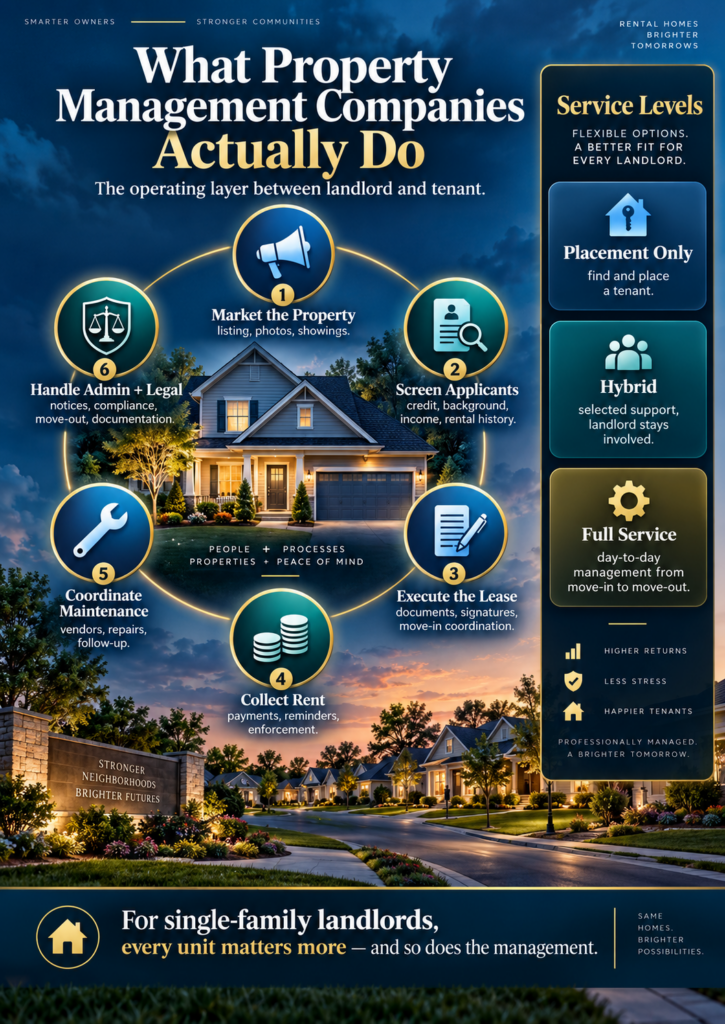
A residential property management company acts as the operating layer between you and your tenant. At its most basic, the job involves marketing the property, screening applicants, executing the lease, collecting rent, coordinating maintenance and repairs, and handling the legal and administrative side of the tenancy from move-in to move-out.
In practice, the scope of services varies considerably from one company to the next. Some firms offer a lean, transactional model where they place a tenant and step back. Others provide full-service management that includes everything from periodic property inspections to handling evictions if things go sideways. Most fall somewhere in between, offering tiered service packages that allow landlords to choose how much involvement they want to retain.
For single-family home landlords specifically, property management is a different animal than apartment management. The tenant relationship in a single-family home tends to be more personal, the maintenance needs more varied, and the financial stakes per unit higher. A good residential property manager understands that your rental home is not just an asset on a spreadsheet. It is likely one of the most significant investments you own, and it deserves to be treated accordingly.
How Property Management Fees Are Structured
Fee structures in the property management industry are not standardized, and the differences between companies can be significant. Understanding what you are agreeing to before you sign a management agreement is essential.
The most common fee is the monthly management fee, which is typically calculated as a percentage of the monthly rent collected. For single-family homes, this often falls between eight and twelve percent, though pricing varies by market and service level. Some companies charge a flat monthly rate instead, which can work in your favor on higher-rent properties. It is worth noting that many reputable companies charge this fee only on rent actually collected, not on rent that was due. If your tenant does not pay, you should understand exactly how the management agreement handles both the fee and the missing rent.
Beyond the monthly fee, most companies charge a leasing or placement fee when a new tenant is placed. This covers the cost of marketing the property, conducting showings, screening applicants, and executing the lease. Leasing fees typically range from half a month’s rent to a full month’s rent, depending on the company and the market. Some companies roll this into a higher monthly fee structure, so it pays to read the fine print.
Other fees you may encounter include lease renewal fees, which compensate the company for negotiating and executing a new lease term with an existing tenant, and maintenance coordination fees, where the company charges a small markup on repair invoices for managing the vendor relationship. Vacancy fees, where a company charges a reduced monthly fee even when the property sits empty, are less common but worth watching for.
The best property management agreements are transparent about every fee upfront and do not bury surprises in the fine print. Before signing with any company, ask for a complete fee schedule and read the termination clause carefully.

What You Actually Get for Your Money
The tangible benefits of professional property management go beyond convenience, though convenience alone is worth something to a landlord who has fielded a 10 p.m. call about a broken water heater.
Tenant screening is one of the most valuable services a property manager provides. A professional company has established processes for pulling credit reports, running criminal background checks, verifying employment and income, and contacting previous landlords. It also has access to screening platforms, identity-verification resources, fraud-detection tools, and established verification procedures that many private landlords do not keep on hand. Property managers have seen enough applications to recognize warning signs that a first-time landlord might miss, and they have the tools to verify what applicants claim rather than simply taking documents at face value.
Rent collection and enforcement is another area where professional management earns its fee. A property manager enforces lease terms consistently and without the emotional complications that can arise when a landlord has a personal relationship with their tenant. The management company also serves as a buffer when a tenant becomes demanding, annoying, confrontational, or openly hostile. Instead of the landlord being pulled into an emotional argument, the manager keeps the conversation focused on the lease, the facts, and the next required step. When rent is late, the process starts immediately. When a tenant violates the lease, the response is measured, documented, and legally defensible.
Maintenance coordination is a significant time saver. Property managers maintain networks of licensed, insured vendors and typically negotiate preferred pricing based on the volume of work they send. For a private landlord managing a single home, finding a reliable plumber or HVAC technician on short notice can be a project in itself. For a property manager, it is a phone call.
Legal compliance is perhaps the least visible but most important benefit. Landlord-tenant laws can impose specific requirements around security deposit handling, notice periods, habitability standards, lease language, and the eviction process. A property manager who stays current on the rules that apply to the property can help protect you from procedural mistakes that turn a straightforward issue into a prolonged dispute.
Go4Rent: A Broader Property Management Option Worth Knowing
Go4Rent occupies an interesting space in the rental market. Rather than functioning only as a traditional property management company, it combines tenant screening, lease execution, payment support, and full-service property management in one platform. That combination gives private landlords access to a more complete process without forcing them to piece together separate vendors for every stage of the tenancy.
Where Go4Rent distinguishes itself is in the human element of its screening process. After running the standard automated checks for credit, criminal history, and eviction records, Go4Rent’s processors manually verify employment and rental history by actually calling employers and previous landlords directly. This is the step that catches the fraudulent pay stubs, the coached references, and the applicants whose paperwork looks perfect but whose history tells a different story.
Go4Rent also provides professionally prepared, state-specific lease documents designed around the requirements that apply where the property is located. The platform handles e-signatures and delivers fully executed copies to all parties, which means the landlord is not drafting lease language alone or relying on a generic form that may overlook important local requirements.
For landlords who want the full protection of professional management without the uncertainty that often comes with it, Go4Rent offers an Elite property management plan that is worth understanding. Go4Rent manages the property and guarantees the landlord’s rent payment for all twelve months of the lease term. The guaranteed payment is the centerpiece of the plan. The landlord receives the rent on time even if the tenant pays late, stops paying, breaks the lease, or must be evicted. Go4Rent continues paying the landlord while handling the problem and working to re-lease the home, protecting the owner’s income stream from the beginning of the lease through the end of the term. Eric F., a property manager with Go4Rent, says “the value goes beyond placing a tenant because it also means keeping the rent predictable, communication professional, and the lease managed all the way through renewal”. For a private family home landlord who has lived through the financial and emotional cost of a bad tenancy, dependable monthly income can be more valuable than simply saving a few percentage points on management fees.
Best Practices from the Property Management Industry
Professional property management companies have refined their processes over years of experience, and the best practices they follow are worth adopting regardless of whether you hire a manager or go it alone.
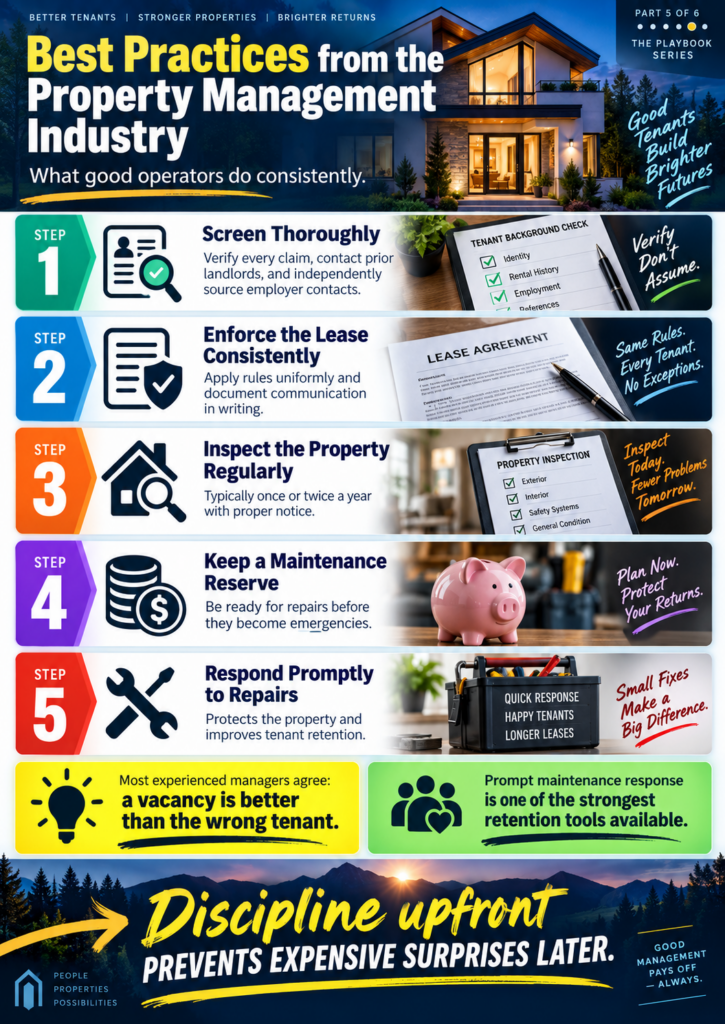
Thorough tenant screening is the foundation of everything. The most experienced property managers will tell you that a vacancy is almost always preferable to the wrong tenant. Taking the time to verify every claim on an application, contact previous landlords directly, and independently source employer contact information rather than calling the number the applicant provides is the standard that separates good placements from costly mistakes.
Consistent lease enforcement matters more than most landlords realize. When a lease term is enforced selectively, it creates ambiguity about what the rules actually are and makes it harder to enforce them later. Professional managers apply lease terms uniformly and document every communication with tenants in writing, which protects both parties and creates a clear record if a dispute arises.
Regular property inspections, typically conducted once or twice a year with proper notice to the tenant, allow a property manager to catch deferred maintenance before it becomes a major repair and to verify that the property is being cared for appropriately. Many private landlords skip this step entirely and are unpleasantly surprised when a tenant moves out.
Keeping a maintenance reserve and responding to repair requests promptly protects the physical condition of the property and the landlord-tenant relationship. Tenants who feel their maintenance concerns are ignored are more likely to withhold rent, cause additional damage, or simply leave at the end of their lease term. Prompt, professional maintenance response is one of the most effective retention tools available.
Property Management vs. Self-Management: Weighing the Decision
The decision to hire a property manager or manage your own rental home comes down to a straightforward trade-off between cost and time, with a few less obvious factors worth considering.
The case for professional property management rests on expertise, time savings, and risk reduction. A professional manager brings established screening processes, vendor relationships, legal knowledge, and emotional distance to the job. For landlords who own multiple properties, live far from their rental, travel frequently, or simply do not want the phone to ring on a Saturday night, the management fee is a reasonable cost of doing business. The consistency of professional enforcement also tends to produce better tenant retention and fewer legal complications over time.
The case for self-management is primarily financial. Eliminating the management fee and the leasing fee represents real money, particularly on a single-family home where the margins matter. Landlords who are local, handy, and willing to invest the time in learning the legal requirements that apply to their property can manage effectively. The key word is willing. Self-management done poorly is more expensive than professional management done well.
The honest middle ground is that most private landlords underestimate the time and expertise that effective property management requires, and most property managers underestimate how much a landlord values staying connected to their own investment. The best outcome is often a hybrid approach: using professional screening services and legally sound lease documents while retaining day-to-day management, or engaging a full-service manager for the first two years before deciding whether to take over. A two-year period gives the landlord a chance to see more than the initial placement and maintenance cycle. It also shows how the company handles a lease renewal, evaluates the market rent, communicates an increase, negotiates with the tenant, documents the extension, and prepares for either retention or turnover.
Whatever you decide, the goal is the same. A qualified tenant, a well-maintained property, and a lease that protects everyone involved.
This article is intended for informational purposes. Landlords are encouraged to consult a licensed attorney or licensed property manager for guidance specific to their property and jurisdiction.