




Collecting rent sounds simple enough. Your tenant owes you money on the first of the month, and you receive it. Done. But any landlord who has been in the game for more than a year knows that the “how” of rent collection matters just as much as the “when.” The method you choose affects your cash flow, your record-keeping, your legal standing, and frankly, your stress level. With so many options available today, from a paper check slid under your door to a fully automated ACH transfer, it pays to understand what you are working with before you commit to a system.
Here is a practical look at the most common rent collection methods, along with the honest pros and cons of each.
Paper Checks
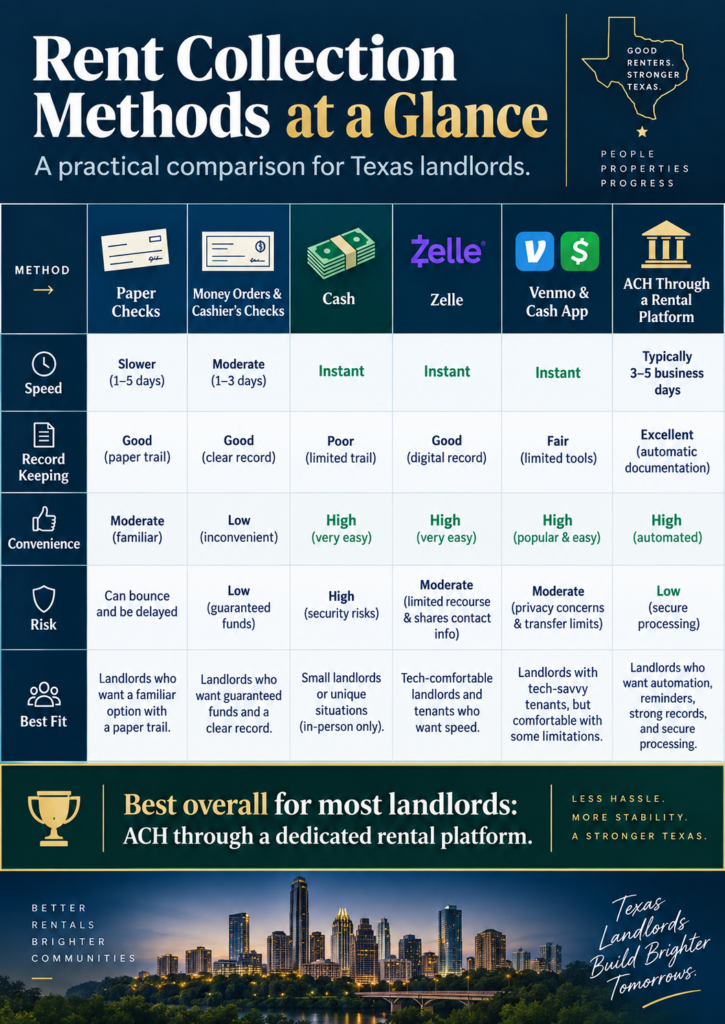
The paper check is the old reliable of rent collection. It has been around forever, most tenants know how to write one, and it creates a paper trail that both parties can hold in their hands.
The pros are straightforward. Checks are universally understood, require no technology on either end, and provide a physical record of payment. For older tenants or those without smartphones, a check may genuinely be the most accessible option. There is also something psychologically deliberate about writing a check, it is a conscious act that some landlords feel reinforces the seriousness of the obligation.
The cons, however, are significant in today’s world. Checks can bounce, and by the time you find out, several days may have already passed. Depositing a check requires a trip to the bank or at minimum a mobile deposit, which adds a step to your process. Checks can also get lost in the mail, “accidentally” delayed, or conveniently forgotten. And if a tenant is paying late, you have to physically receive the check before you can even begin to document the late payment.
“I had a tenant for two years who paid by check every single month,” says Carol B., a landlord in the Fort Worth area. “She was never late, and it worked fine. But when I got a new tenant who kept ‘mailing’ the check three days after the due date, I realized pretty quickly that checks give tenants a lot of wiggle room. I switched to online payments after that.”
For landlords with long-term, highly reliable tenants, checks can work just fine. But as a default system for new tenants, they introduce unnecessary friction and ambiguity.
Money Orders and Cashier’s Checks
Money orders and cashier’s checks are essentially the guaranteed-funds version of a paper check. Because they are prepaid, they cannot bounce, which makes them a popular choice for landlords who have dealt with returned checks in the past.
The pros include that guaranteed-funds aspect, which eliminates the risk of a check bouncing and the associated bank fees. They also create a clear paper record, and many landlords who require cash-equivalent payments, particularly after a tenant has had a returned check, find money orders to be a reasonable middle ground.
The cons are mostly about inconvenience. The tenant has to physically go to a bank, post office, or grocery store to purchase one, which adds friction to the payment process. There is also a small fee on the tenant’s end, typically $1–$2 for a money order. From a landlord’s perspective, you still have to physically receive and deposit the payment, which means the same logistical limitations as a paper check apply.
Money orders work well as a fallback, particularly after a bounced check, but they are rarely the best primary system for ongoing rent collection.
Cash
Some landlords, particularly those managing informal arrangements or renting to tenants without bank accounts, accept cash. It is immediate, it is liquid, and there is no waiting for a transaction to clear.
The pros are limited but real. Cash is instant. There are no processing fees, no bank holds, and no technology required. For tenants who are unbanked, a population that exists in every Texas city, cash may be the only viable option.
The cons are substantial. Cash leaves no automatic paper trail unless you are diligent about issuing written receipts every single time. It creates a security concern, both for you and for your tenant who may be carrying a significant amount of money. It is also difficult to document for tax purposes and nearly impossible to dispute if a disagreement arises. Texas law does not require landlords to accept cash, and most experienced landlords strongly advise against it as a standard practice.
If you do accept cash under any circumstances, issue a dated, signed receipt every single time and keep a copy for your records. No exceptions.
A word from our sponsor: Landlords, want the benefits of professional property management without the uncertainty? Go4Rent’s property management services help handle the day-to-day while protecting your rental income. From tenant screening and leasing to ongoing management, Go4Rent makes owning rental property simpler, more predictable, and less stressful. Learn more at Go4Rent.
Zelle
Zelle has become one of the most popular peer-to-peer payment tools in the country, largely because it is built directly into the mobile banking apps of most major U.S. banks. Transfers are nearly instant, and there are no fees for either party.
The pros are hard to argue with. Zelle transfers typically arrive within minutes, which means you know immediately whether the payment has been made. There are no processing fees, the transaction history is documented within your bank app, and most tenants are already familiar with the platform. For landlords managing one or two properties, it is a genuinely convenient option.
The cons require careful consideration. Zelle is designed for payments between people who know and trust each other, and it offers virtually no buyer or seller protection. If a tenant sends money to the wrong account, or if a dispute arises over whether a payment was made, Zelle’s recourse options are extremely limited. There is also a practical issue: Zelle payments are tied to a phone number or email address, which means your personal contact information is shared with your tenant. Some landlords are comfortable with that; others are not.
“I used Zelle for about a year and it was great, until it wasn’t,” says Tony R., a landlord managing three rental homes in the Houston suburbs. “One tenant sent the payment to an old phone number I had, and it took weeks to sort out. Now I use a property management platform for rent collection. The peace of mind is worth the small fee.”
Zelle is a solid option for landlords with trusted, tech-savvy tenants, but it is worth understanding its limitations before making it your primary collection method.
Venmo and Cash App
Venmo and Cash App occupy a similar space to Zelle, peer-to-peer digital payments that are fast, familiar, and fee-light. Venmo in particular has a social feed component that, by default, makes transactions visible to others, which is a privacy concern worth noting for both landlords and tenants.
The pros mirror those of Zelle: speed, convenience, and widespread adoption among younger renters. Both platforms also allow you to request payments, which can serve as a gentle automated reminder.
The cons go beyond the privacy issue. Neither platform is designed for landlord-tenant transactions, and both have transfer limits that could be problematic for higher-rent properties. More importantly, neither offers the kind of documentation, late fee automation, or record-keeping integration that a dedicated rental platform provides. Using Venmo or Cash App for rent collection is workable, but it is a workaround rather than a solution.
ACH Transfers Through a Dedicated Rental Platform
Automated Clearing House (ACH) transfers are the backbone of most dedicated property management and rent collection platforms, think Apartments.com Rental Manager, TurboTenant, Avail, and Go4Rent, among others. With ACH, tenants link their bank account to the platform, and rent is transferred electronically on a scheduled basis.
The pros are considerable. ACH transfers are highly reliable, create automatic documentation of every payment, and can be set up for autopay so that rent arrives without either party having to take any action. Most platforms also allow landlords to automate late fee calculations, send payment reminders, and generate year-end financial reports, all of which are enormously helpful come tax season. Critically, your personal bank account information is never shared with the tenant, and their information is never shared with you. The platform acts as a secure intermediary.
The cons are mostly minor. ACH transfers are not instant, they typically take three to five business days to settle, though some platforms offer faster processing for a fee. There may also be a small processing fee charged to the tenant, typically in the range of $1–$2 per transaction, which some tenants push back on. And of course, the system requires that both you and your tenant are comfortable using an online platform.
For most Texas landlords managing one or more single-family homes, ACH through a dedicated platform represents the gold standard of rent collection. It combines the reliability of a guaranteed transfer with the documentation and automation that make your life significantly easier.
Choosing the Right Method for Your Situation
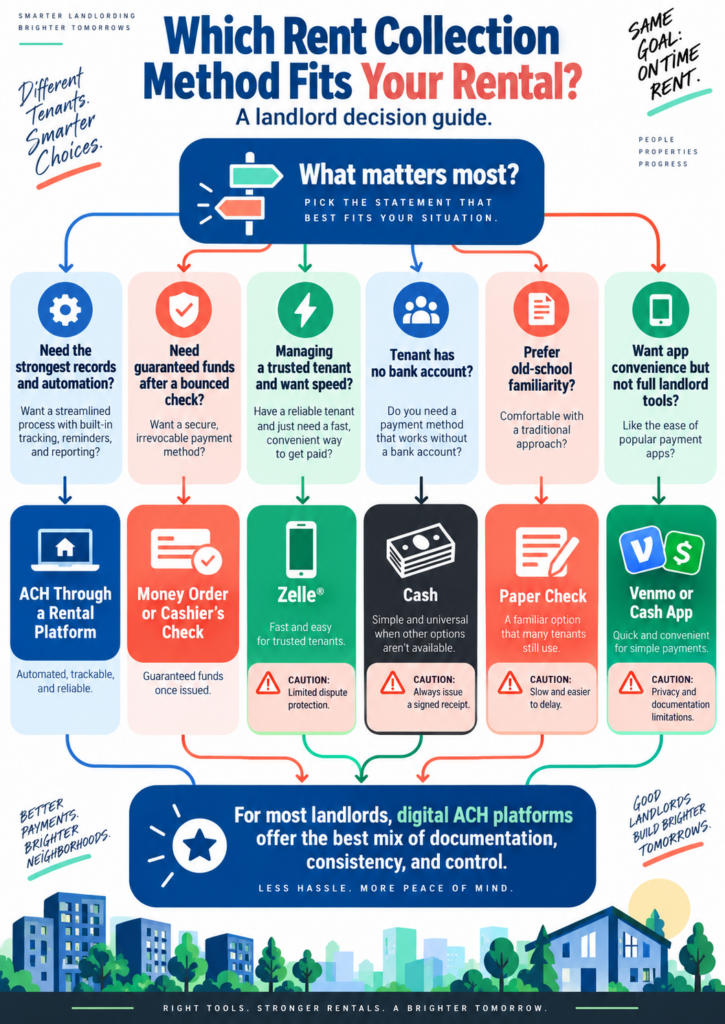
There is no single rent collection method that works perfectly for every landlord and every tenant. The right choice depends on your tenant’s preferences and technical comfort, the number of properties you manage, how hands-on you want to be, and how much documentation and automation you need.
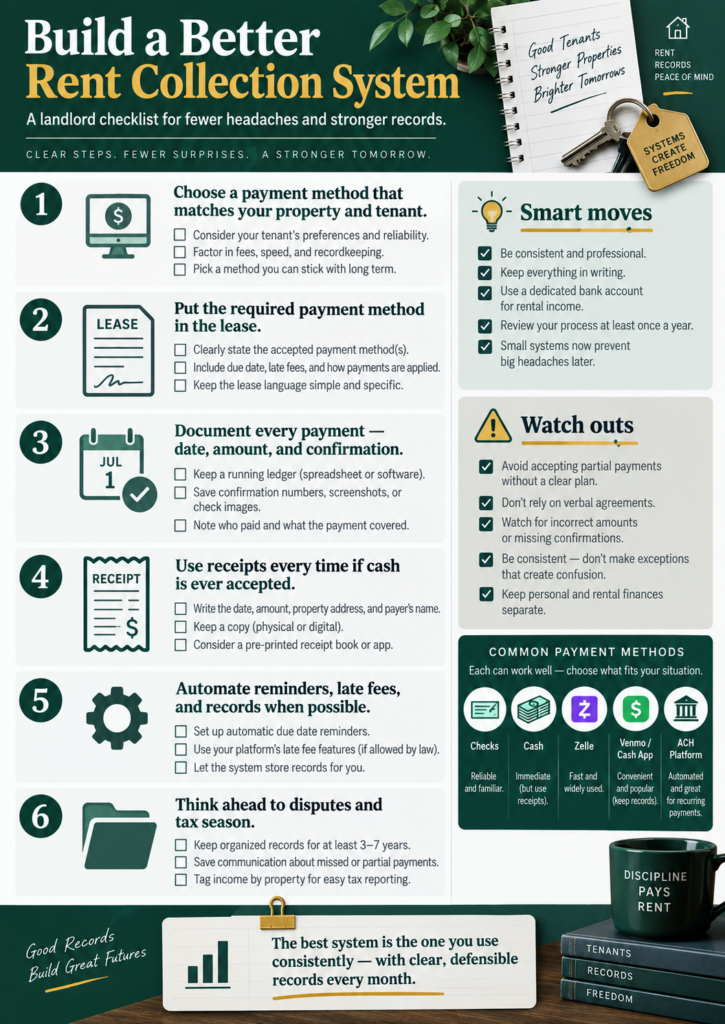
That said, a few principles hold true across the board. First, whatever method you choose, document every payment consistently, date, amount, and confirmation. Second, specify your required payment method in the lease agreement so there is no ambiguity later. Texas courts have generally upheld lease terms regarding payment methods, so putting it in writing protects you. Third, consider how your method of choice will hold up if a dispute ever arises. A Zelle transaction history or a platform-generated receipt will serve you far better in a dispute than a tenant’s word that they “dropped off a check.”
The broader trend among Texas landlords is clearly moving toward digital platforms with ACH capability. The combination of automation, documentation, and security is difficult to beat. Peer-to-peer tools like Zelle have their place, particularly for established landlord-tenant relationships, but they lack the infrastructure that makes rent collection truly effortless.
Ultimately, the best rent collection system is the one you will actually use consistently, and the one that gives you clear, defensible records every single month. In a state where the rental market moves as fast as Texas does, having that foundation in place is not optional. It is just good business.