




Rental fraud is not a new problem. Landlords have been dealing with dishonest applicants for as long as there have been rental properties. What has changed, dramatically, is how easy it has become to commit it. A fake pay stub that once required a skilled forger can now be generated online in under ten minutes for less than fifty dollars. Convincing bank statements can be downloaded from template sites and edited in free software. Entire fake identities can be assembled from real and fabricated information that passes a cursory review without raising a single flag.
A 2023 survey by the National Multifamily Housing Council found that 80 percent of landlords and property managers had caught renters misrepresenting themselves on rental applications within the prior year, and 84 percent had encountered falsified references or supporting documentation. For private family home landlords in Texas, who typically do not have the resources of a large property management company, the risk is just as real and the consequences are often more personal.
Understanding the types of fraud that exist, where they show up in the application process, and how to protect yourself is not paranoia. It is basic due diligence.

Document Fraud: The Most Common and Most Dangerous
Document fraud is the most prevalent form of rental application fraud, and it is estimated that roughly one in eight rental applications contains falsified or altered documents. The most common targets are pay stubs and bank statements, the two pieces of paper most landlords rely on most heavily to verify income.
Pay stub fraud has become alarmingly accessible. Dozens of websites openly advertise pay stub generation services, offering customizable templates that can be populated with any employer name, income figure, and date the applicant chooses. The resulting documents often look indistinguishable from legitimate pay stubs to the untrained eye. The fonts are right, the formatting is professional, and the numbers are whatever the applicant needs them to be. Bank statement fraud follows a similar pattern, with applicants editing PDF files to inflate balances, remove overdraft entries, or eliminate records of returned payments. Some go further, using entirely fabricated statements that mimic the formatting of major national banks. Without independently verifying the information, a landlord reviewing these documents has no reliable way to know what is real.
This is precisely where professional screening services with experienced processors have a significant advantage over a landlord working alone. Go4Rent’s processors are specifically trained to identify fraudulent documents and review enough applications each month to recognize the subtle formatting irregularities and inconsistent details that often distinguish a fabricated pay stub from a legitimate one, pattern recognition that is nearly impossible to develop without exposure to a high volume of both genuine and fraudulent submissions.
“We see fake pay stubs and altered bank statements more than most landlords would ever expect,” says Mark G., office manager at Go4Rent. “The documents look legitimate at first glance, the right logo, the right layout, everything formatted correctly. But when our processors call the employer directly to verify income, the employer lets us know that the applicant never worked there, or they were let go months ago. That’s fraud, and it’s exactly why manual verification exists.”
Other documents that are frequently falsified include W-2 forms, offer letters, and tax returns. Some applicants go so far as to create fake employer contact information, listing a phone number that routes to a friend or family member who will pose as an HR representative. This is why verification services that independently source employer contact information, rather than relying on what the applicant provides, are so critical.
Fake IDs and Fraudulent Social Security Numbers
One of the more alarming trends in rental application fraud involves applicants who do not just misrepresent their finances, they misrepresent who they are entirely. The use of fake government-issued identification and fraudulent Social Security numbers has become an increasingly common tactic, particularly among applicants who have prior evictions, criminal histories, or other barriers that would otherwise disqualify them.
A fraudulent driver’s license or state ID can be obtained through online channels with relative ease, and the quality of these documents has improved significantly in recent years. To a landlord reviewing a photocopy or a smartphone photo of an ID, a convincing fake may be indistinguishable from a legitimate one. Some applicants pair a fake ID with a Social Security number belonging to a real person with a clean credit history, generating a favorable credit report under a false name. Others use fabricated numbers that have never been issued, or numbers belonging to deceased individuals, which can slip through automated screening systems that do not cross-reference identity data rigorously.
The consequences for a landlord who unknowingly signs a lease with someone using a false identity can be severe. If problems arise, non-payment, property damage, or criminal activity, the person named on the lease may not legally exist, or may be an innocent third party whose identity was stolen. Pursuing legal remedies, including eviction, becomes significantly more complicated when the true identity of the occupant is in question.
Requesting a government-issued photo ID in person, rather than accepting a digital copy, allows for a closer inspection of security features such as holograms, microprinting, and raised lettering that are difficult to replicate convincingly. Running the applicant’s name, date of birth, and Social Security number through an identity verification check, rather than relying solely on a credit pull, can flag mismatches between the name on the application and the name associated with that number in federal records. SSN trace reports map the history of addresses and names tied to a given number and can surface inconsistencies that suggest fraud. A Social Security number that returns a credit profile under a different name, or one that does not match the applicant’s stated history in any meaningful way, warrants serious scrutiny before proceeding.
Go4Rent’s processors are trained specifically in identity verification and experienced in spotting the warning signs of fraudulent identification and fake Social Security numbers. Where an automated system may simply pull a credit report and move on, a trained processor knows to question a mismatch between the name on the ID and the SSN in federal records, and to escalate that discrepancy before it becomes a signed lease.

Identity Fraud: Hiding Behind Someone Else
Identity fraud in the rental context typically takes one of two forms: using a stolen identity or borrowing a family member’s identity with or without their knowledge. Stolen identity fraud allows a fraudster to benefit from a victim’s clean credit history and employment record while concealing their own history of evictions, criminal activity, or non-payment. The legitimate tenant whose identity was used often does not discover it until they try to rent elsewhere and find a lease they never signed on their record.
Family identity fraud is more common than most people realize. An applicant with a poor credit history or a prior eviction may use a sibling’s, parent’s, or spouse’s identity, sometimes with that person’s cooperation, sometimes without it, leaving the landlord with a lease signed by someone who is not actually living in the property. A more sophisticated variant is synthetic identity fraud, where an applicant combines a legitimate Social Security number with fabricated personal details to create a blended identity that does not match any single real person. These synthetic identities are particularly difficult to catch because they do not trigger the same alerts as outright stolen identities, and they are becoming more prevalent as digital tools make identity construction easier.
Fraudulent References: The Fake Landlord Problem
A previous landlord who enthusiastically vouches for an applicant is reassuring. A previous landlord who is actually the applicant’s college roommate playing a role is something else entirely.
Fraudulent references are a widespread and under-appreciated form of rental fraud. An applicant with a history of late payments, property damage, or a prior eviction has every incentive to ensure their “previous landlord” tells a different story. All it takes is a willing friend and a few minutes of coaching. The red flags are there if you know what to look for. A reference who cannot provide specific details about the property, the lease term, or the security deposit amount is a warning sign. A reference whose phone number does not match any listed property management company or whose name does not appear in public property ownership records should prompt further investigation.
Professional verification services are trained specifically to probe for these inconsistencies. They independently confirm that the person being contacted actually owns or manages the property in question, by cross-referencing public property ownership records, before treating the reference as credible. A private landlord making the same call has no reliable way to perform that cross-check in real time.
Nondisclosure: The Fraud of Omission
Not all rental fraud involves fabricated documents or stolen identities. Some of it is simply a matter of leaving things out. Nondisclosure fraud occurs when an applicant deliberately omits information they know would result in a denial, a prior eviction, a previous address with a negative rental history, a co-occupant with a criminal record, or undisclosed pets in a no-pet property.
This type of fraud is harder to detect because it does not leave an obvious paper trail. It relies on the landlord not asking the right questions or not looking closely enough at gaps in the application. An applicant who claims to have lived at their current address for five years but cannot provide a landlord reference before that, and conveniently cannot remember where they lived previously, is exhibiting a classic nondisclosure pattern. A thorough rental history verification covering a full two years, with careful follow-up on any gaps or inconsistencies in the timeline, is the most effective defense against this type of fraud.
Where Fraud Happens Most
Rental fraud tends to cluster around moments of high demand and low scrutiny. In competitive Texas markets like Houston, Dallas, Austin, and San Antonio, landlords under pressure to fill vacancies quickly are more likely to cut corners on verification. Fraudsters know this and exploit it. Fraud also concentrates at the income threshold, where applicants who fall just below the standard three-times-rent requirement need only adjust a number on a pay stub rather than fabricate an entirely new identity.
Single-family home rentals are disproportionately targeted because private landlords are perceived, often correctly, as less likely to have sophisticated verification systems than large apartment communities. A fraudster deterred by a corporate property management company’s document authentication software will often redirect their efforts toward the private landlord down the street.
Protecting Yourself
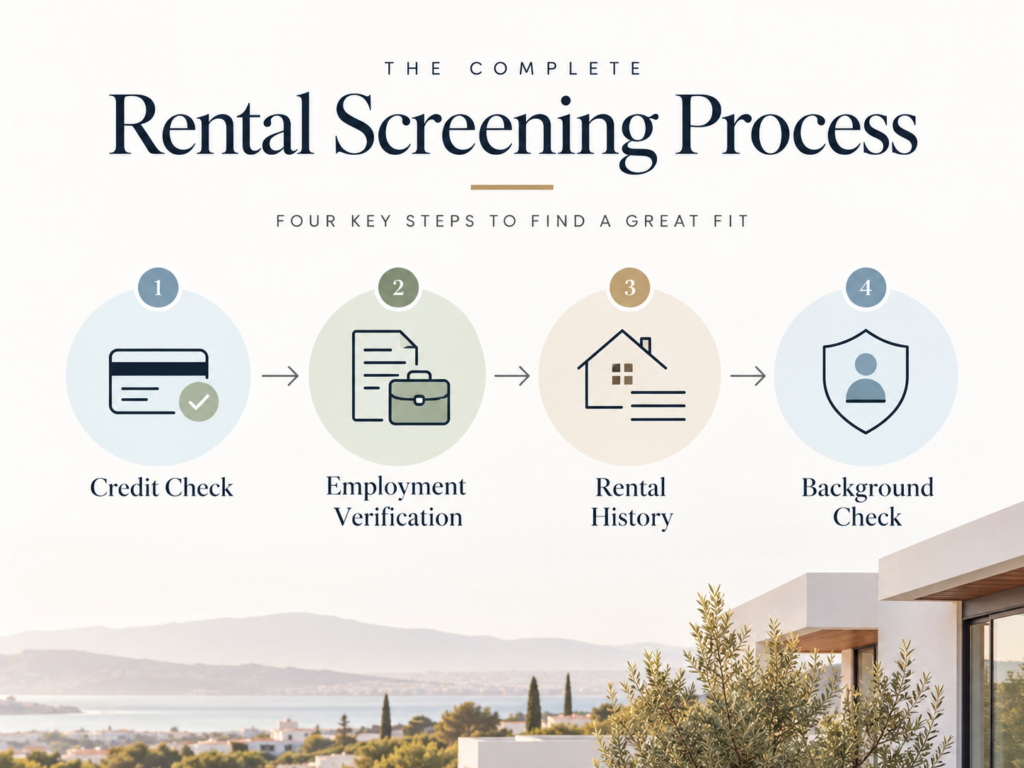
The most effective protection against rental fraud is a screening process that does not rely solely on what the applicant provides. Automated credit and background checks are a necessary starting point, but they are not sufficient on their own. Manual employment verification using independently sourced contact information, rental history verification involving direct contact with previous landlords, and careful scrutiny of all submitted documents are the layers that close the gaps.
Working with a dedicated third-party screening service like Go4Rent is one of the most effective steps a Texas landlord can take. Go4Rent’s processors are specifically trained to identify fraudulent documents, fake identities, and suspicious Social Security numbers, and they bring to every application a level of pattern recognition that only comes from reviewing a high volume of both legitimate and fraudulent submissions. Where a private landlord might see a polished pay stub and move on, a Go4Rent processor asks the questions that catch fraud before it costs you months of lost rent and legal fees.
Trust the process, not the presentation. A charming applicant and a stack of professional-looking documents are not proof of anything. Verification is.
This article is intended for informational purposes. Landlords are encouraged to consult a licensed attorney for guidance specific to their situation and jurisdiction.